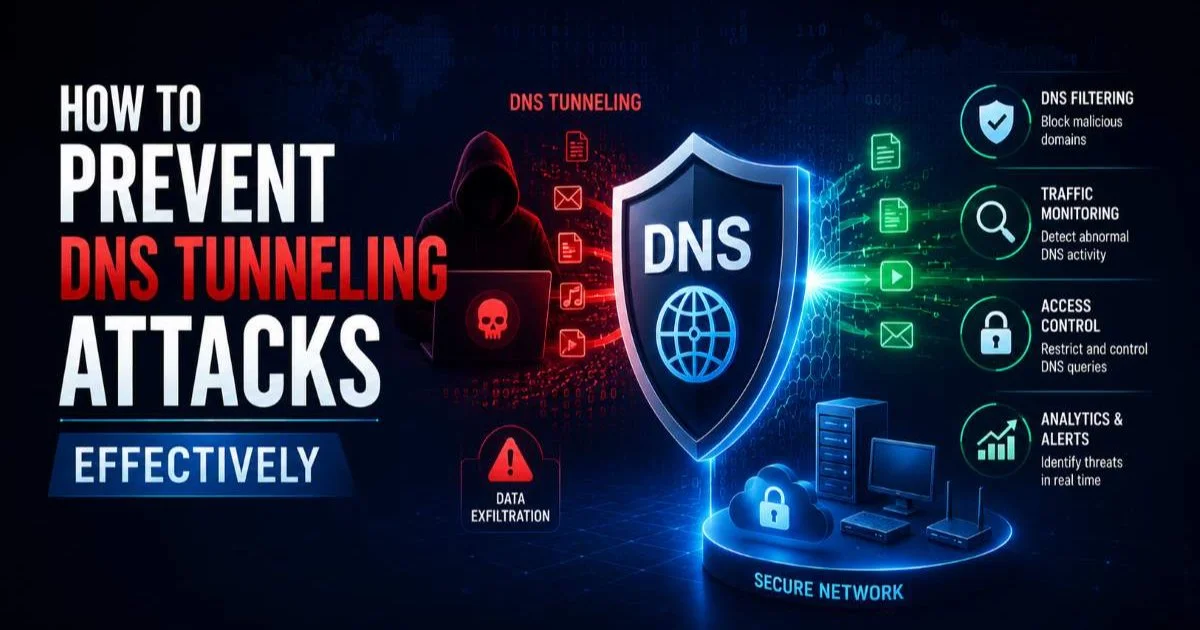
How to prevent DNS tunneling attacks effectively is one of the most pressing questions facing IT security teams today. DNS tunneling exploits the fundamental trust placed in DNS traffic, allowing attackers to exfiltrate data, establish command-and-control channels, and bypass firewalls by encoding malicious payloads within DNS queries and responses.
Because port 53 traffic is rarely blocked or deeply inspected, it represents a blind spot in many organizations' defenses. The consequences range from prolonged data breaches to complete network compromise, often undetected for weeks or months. Understanding the mechanics behind these attacks is the first step toward building a resilient defense, and the practical steps outlined here will give your security team a concrete action plan.
Key Takeaways
- DNS tunneling hides malicious data inside normal-looking DNS queries and responses.
- Payload analysis and traffic baselining are your two strongest detection methods.
- Restricting DNS resolvers to authorized servers dramatically reduces your attack surface.
- AI-powered monitoring tools catch anomalies that signature-based systems miss entirely.
- Regular security audits of DNS infrastructure should happen at least quarterly.
Step 1: Understand How DNS Tunneling Works
Before you can defend against DNS tunneling, you need to understand exactly what happens during an attack. An attacker sets up an authoritative DNS server for a domain they control (for example, evil.example.com). They then install a tunneling client on a compromised endpoint inside your network. The client encodes stolen data or C2 instructions into DNS queries, typically using TXT, CNAME, or MX record types, and sends them to the attacker's server through your legitimate DNS resolvers. To learn more about the foundational concepts, read our guide on what DNS security is, with definitions, examples, and how it works.
Anatomy of a DNS Tunneling Attack
The encoded data appears as subdomain labels in the query. A normal query might resolve "mail.google.com," but a tunneling query would look like "dGhpcyBpcyBzdG9sZW4gZGF0YQ.evil.example.com," where the subdomain is actually Base64-encoded exfiltrated data. Responses from the attacker's server carry instructions or acknowledgments in the DNS response records. This back-and-forth creates a covert bidirectional channel that traditional firewalls simply do not inspect.
Popular tools like iodine, dnscat2, and dns2tcp make launching these attacks straightforward. Iodine can achieve throughput of up to 680 kbps through DNS alone, which is more than enough to exfiltrate sensitive documents over a few hours. Attackers also increasingly use DNS over HTTPS (DoH) to further obscure their tunneling traffic from network security devices, making detection even more challenging for traditional inspection tools.
DNS tunneling tools are freely available on GitHub, meaning any moderately skilled attacker can deploy them within minutes against your network.
Understanding these mechanics is critical because it shapes every defensive decision you make. If you only look for known signatures of specific tools, you will miss custom implementations. If you only inspect A records, you will miss tunneling via TXT or NULL records. A thorough understanding of the protocol abuse patterns ensures your defensive strategy covers the full spectrum of attack variations.
Step 2: Establish Baseline Monitoring and Detection
You cannot detect anomalous DNS behavior without first knowing what normal behavior looks like. Start by capturing at least 30 days of DNS query logs from your recursive resolvers. Record query volumes per client, response sizes, queried domain distributions, and record type frequencies. This baseline becomes the reference point against which you measure deviations. Most organizations discover during this process that they lack comprehensive DNS logging, which is itself a vulnerability worth addressing immediately.
Read also What Is an Open Graph Tag? Definition & How It Works
Key Metrics to Track
Several specific indicators reliably flag DNS tunneling activity. Watch for unusually long subdomain labels (legitimate subdomains rarely exceed 30 characters, while tunneling queries frequently hit the 63-character label limit). High query volumes to a single domain from a single host, especially when the domain has very low global popularity, strongly suggest tunneling. Response payloads that are consistently large, particularly TXT records exceeding 200 bytes, also warrant investigation.
Set alerts for any internal host generating more than 500 DNS queries per minute to a single domain. Normal browsing behavior almost never triggers this threshold.
| Indicator | Normal Range | Suspicious Threshold | Detection Method |
|---|---|---|---|
| Subdomain label length | 5-25 characters | >50 characters | Payload inspection |
| Query volume per host | 50-200/min | >500/min to one domain | Traffic analysis |
| TXT response size | 50-150 bytes | >200 bytes consistently | Response monitoring |
| Entropy of query strings | 2.5-3.5 bits/char | >4.0 bits/char | Statistical analysis |
| NXDomain response rate | <5% | >20% for one domain | Log correlation |
Entropy analysis deserves special attention here. Legitimate domain names use common English words and predictable character distributions, resulting in relatively low Shannon entropy values. Tunneling payloads, whether Base32 or Base64 encoded, produce character distributions with significantly higher entropy. Tools like PassiveDNS and Zeek (formerly Bro) can compute entropy values in real time. An entropy value consistently above 4.0 bits per character on subdomain strings is a strong tunneling signal.
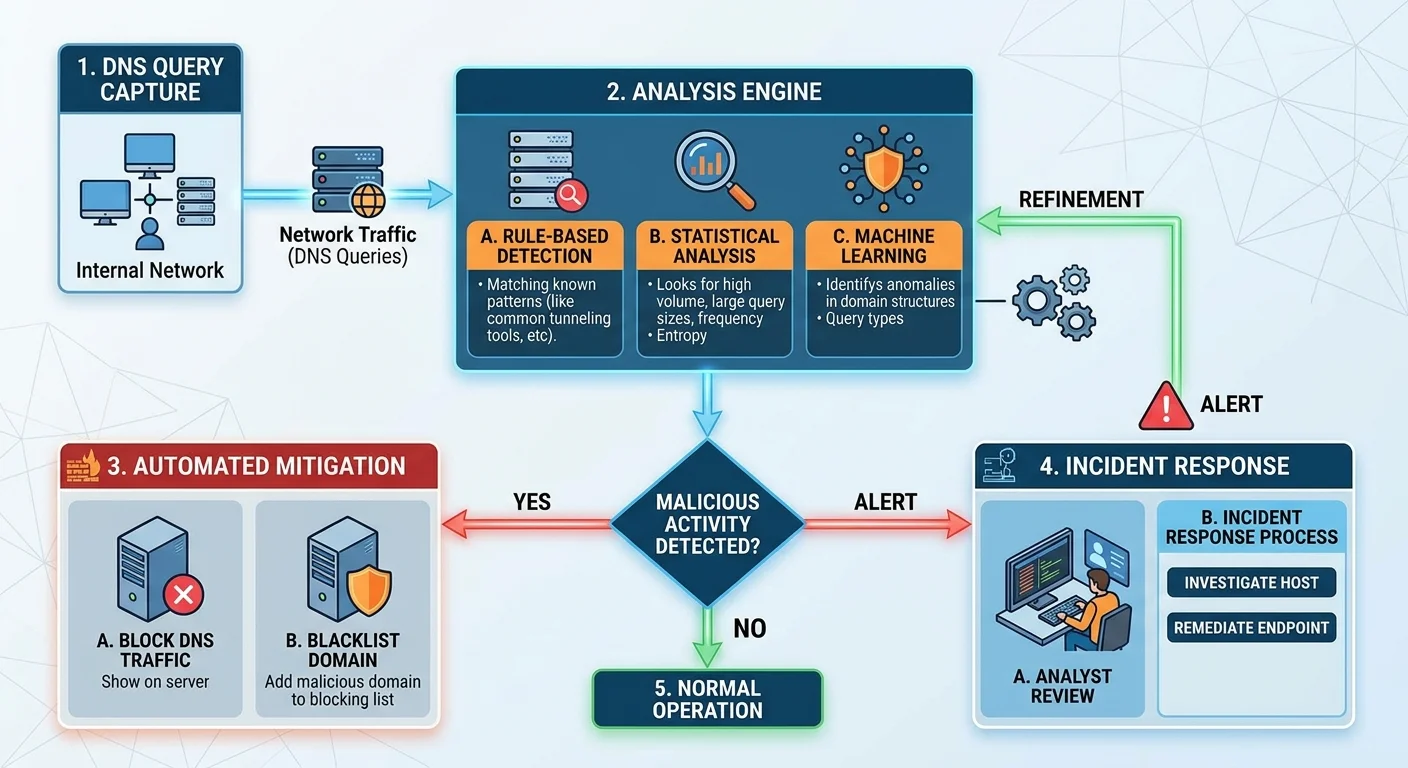
Deploy your monitoring at the recursive resolver level rather than at individual endpoints. This gives you visibility across the entire network from a single collection point. Forward DNS logs to your SIEM platform and build correlation rules that combine multiple indicators. A single anomaly might produce a false positive, but the combination of high entropy, long subdomains, and elevated query volume to an obscure domain strength creates a high-confidence detection signal.
Step 3: Harden Your DNS Infrastructure
Detection alone is not enough. You should architect your DNS infrastructure to make tunneling significantly harder to execute in the first place. The most impactful step is restricting all DNS traffic to flow through a small number of managed, internal recursive resolvers. Configure your firewall to block outbound port 53 traffic from all hosts except those designated resolvers. This forces every DNS query through your inspection and logging pipeline, eliminating the possibility of endpoints reaching attacker-controlled resolvers directly.
Resolver Lockdown Strategies
On your managed resolvers, implement DNS response policy zones (RPZs) to block queries to known malicious domains. Subscribe to threat intelligence feeds that specifically track domains associated with tunneling infrastructure. Additionally, configure your resolvers to reject queries with excessively long labels or unusually high record type diversity from a single source. BIND, Unbound, and PowerDNS all support these restrictions through configuration directives or plugin modules.
Blocking DNS over HTTPS (DoH) at the network perimeter is increasingly necessary, as attackers use it to bypass traditional DNS inspection entirely. Consider implementing TLS inspection for outbound HTTPS traffic to known DoH providers.
Network segmentation plays a vital role in limiting tunneling effectiveness. Workstations in your general network should only resolve through internal resolvers, while servers in your DMZ might use different resolvers with stricter policies. Apply the principle of least privilege to DNS access: database servers, for instance, rarely need to resolve arbitrary external domains. Creating segmented DNS policies, similar to how you apply cloud data security best practices, reduces the blast radius if any single endpoint becomes compromised.
"The most effective DNS tunneling defense combines architectural restrictions with behavioral monitoring, because neither approach alone covers every attack vector."
Consider deploying DNSSEC validation on your resolvers. While DNSSEC does not directly prevent tunneling, it makes certain attack techniques harder by requiring valid cryptographic signatures on DNS responses. Attackers using tunneling through domains without proper DNSSEC records can be flagged or blocked if your resolver enforces validation. Additionally, implement DNS query rate limiting on your resolvers to throttle any single client that generates excessive query volumes, reducing the throughput available to a tunneling channel.
Step 4: Deploy Advanced Defense and Response Mechanisms
Learning how to prevent DNS tunneling attacks effectively at scale requires moving beyond static rules into intelligent, adaptive defense. Traditional signature-based detection catches known tools like iodine and dnscat2, but custom tunneling implementations or modified tool variants will slip through. This is where machine learning and behavioral analytics prove their worth. Modern DNS security platforms analyze query patterns in real time, building dynamic models of normal behavior and flagging deviations with far greater accuracy than static thresholds.
AI-Powered Detection Systems
AI-powered DNS security solutions examine features like query timing patterns, character frequency distributions, domain generation algorithm (DGA) characteristics, and cross-referencing with global threat intelligence. These systems can identify a tunneling channel within its first few hundred queries, long before significant data exfiltration occurs. When selecting a platform, prioritize solutions that offer both real-time blocking and forensic analysis capabilities, since you need both immediate response and post-incident investigation tools.
Build a documented incident response playbook specifically for DNS tunneling events. When your monitoring systems flag a potential tunnel, your team needs clear steps: isolate the affected endpoint, capture a full packet trace of DNS traffic, identify the destination domain and its registration details, check for lateral movement, and assess what data may have been exfiltrated. Practice this playbook through tabletop exercises at least twice per year. Speed matters because every minute a tunneling channel operates is another opportunity for data loss.
Finally, integrate DNS security into your broader security operations workflow. Understanding how to prevent DNS tunneling attacks effectively requires ongoing attention, not a one-time configuration. Schedule quarterly reviews of your DNS policies, resolver configurations, detection rules, and threat intelligence feeds. Audit your firewall rules to confirm that outbound DNS restrictions remain intact after network changes. Test your own defenses by running controlled tunneling exercises using tools like dnscat2 in a lab environment, validating that your monitoring systems detect and alert on the simulated attack within acceptable timeframes.
Run quarterly red team exercises specifically targeting DNS tunneling. If your own team can successfully tunnel data out without triggering alerts, attackers can too.
Frequently Asked Questions
?How do I baseline DNS traffic to spot tunneling anomalies?
?Is blocking DoH enough to stop DNS tunneling over HTTPS?
?How long does it take to harden DNS resolvers against tunneling?
?Does signature-based detection catch iodine or dnscat2 traffic?
Final Thoughts
DNS tunneling remains one of the most effective and underestimated attack vectors in enterprise networks. Knowing how to prevent DNS tunneling attacks effectively means combining architectural hardening, continuous monitoring, and intelligent detection into a layered defense.
No single tool or configuration eliminates the risk entirely, but the steps outlined here dramatically reduce both the likelihood and impact of a successful attack. Treat DNS security as a living practice rather than a static project, and your organization will be far better positioned to stop these threats before they cause real damage.
Disclaimer: Portions of this content may have been generated using AI tools to enhance clarity and brevity. While reviewed by a human, independent verification is encouraged.