
Understanding what is DNS security, its definition, examples, and how it works becomes urgent when you consider that DNS cache poisoning remains one of the most effective and underestimated attack vectors facing modern networks. This attack manipulates the very system your organization depends on to resolve domain names, redirecting legitimate traffic to malicious destinations without triggering obvious alarms.
For IT security professionals, the threat is real: a single poisoned cache entry can compromise thousands of users in minutes. The consequences range from credential theft to full-scale data exfiltration. Unlike many attack types that require sophisticated initial access, cache poisoning exploits fundamental trust relationships baked into the DNS protocol itself.
This guide walks you through exactly how the attack works, how to detect it, and the concrete steps you need to take to stop it. As covered in our comprehensive overview of DNS security fundamentals, protecting your DNS infrastructure is foundational to broader network defense.
Key Takeaways
- DNS cache poisoning injects forged records into resolver caches to redirect traffic silently.
- DNSSEC validation is the single most effective defense against cache poisoning attacks.
- Randomizing source ports and transaction IDs dramatically raises the attacker's difficulty.
- Reducing TTL values on critical records limits the window of exposure from poisoned entries.
- Continuous DNS monitoring and logging are necessary to detect poisoning attempts early.
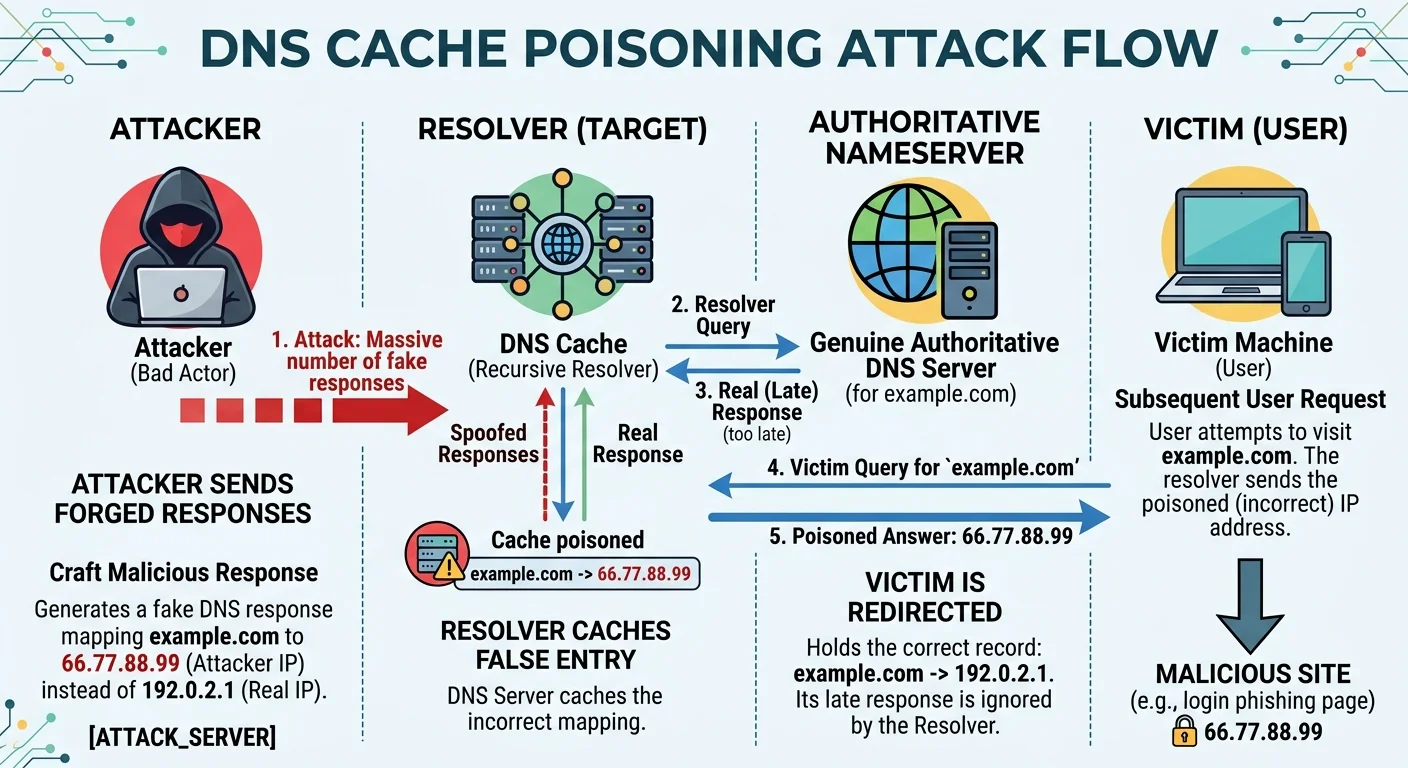
Step 1: Understand How DNS Cache Poisoning Works
The Attack Sequence
DNS cache poisoning targets recursive resolvers, the servers that look up domain names on behalf of end users. When a resolver doesn't have a cached answer for a query, it reaches out to authoritative nameservers. During this brief window, the attacker floods the resolver with forged responses that appear to come from the legitimate authoritative server. If the attacker's spoofed packet arrives before the real response and matches the transaction ID and source port, the resolver accepts the forged record and caches it.
The classic version of this attack was demonstrated by Dan Kaminsky in 2008, revealing that resolvers using predictable transaction IDs and fixed source ports were trivially exploitable. The attacker doesn't need to intercept any traffic. They simply need to win a race condition by sending enough spoofed responses. Once the poisoned record is cached, every user querying that resolver for the targeted domain gets directed to the attacker's IP address for the duration of the record's TTL.
Why Resolvers Are Vulnerable
The fundamental vulnerability lies in the fact that DNS was designed in an era where trust was implicit. Standard DNS queries and responses travel over UDP, which is connectionless and trivially spoofable. The only authentication mechanisms in plain DNS are a 16-bit transaction ID and the source port number. That gives an attacker a relatively small keyspace to brute-force, especially when the source port is predictable or reused across queries.
Open resolvers are particularly at risk because anyone on the internet can trigger queries against them, creating the race condition window the attacker needs. Even private resolvers can be targeted if the attacker can predict when a query will be made, perhaps by sending a phishing email containing an image hosted on a domain they control. The resolver's query for that domain opens the attack window.
Open recursive resolvers are the highest-risk targets for cache poisoning. Restrict resolver access to authorized networks only.
Step 2: Detect Cache Poisoning in Your Environment
Monitoring Techniques
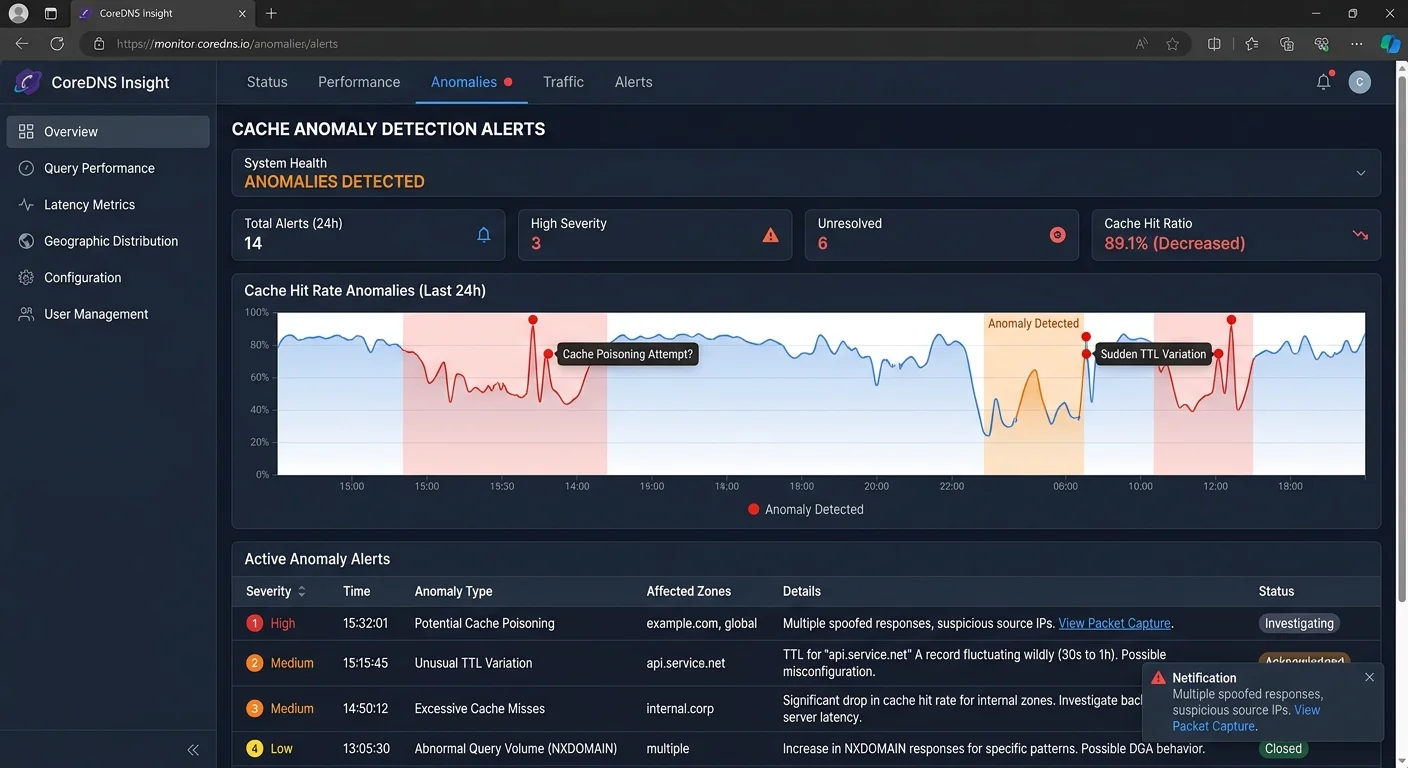
Detection starts with visibility. If you aren't logging DNS queries and responses at your resolver level, you're flying blind. Deploy passive DNS monitoring that captures query/response pairs and stores them for analysis. Tools like passivedns or commercial DNS monitoring platforms can record the responses your resolvers are caching, letting you compare them against known-good authoritative data. Any discrepancy between what your resolver cached and what the authoritative server actually serves is a red flag.
You should also monitor for unusual query patterns directed at your resolvers. A cache poisoning attempt generates a high volume of spoofed responses, and while you may not see those directly, you'll often see corresponding patterns: repeated queries for the same domain from a single source, or a sudden spike in NXDOMAIN responses. Setting up alerting thresholds on these metrics through your SIEM provides an early warning system that catches poisoning attempts before they succeed.
Also Check: How Backlink Analysis Boosts Domain SEO Strength
Configure your DNS monitoring to alert when a cached record's IP address changes unexpectedly, especially for high-value domains like banking or authentication services.
Anomaly Indicators
Beyond query volume, look for TTL anomalies. A poisoned record often arrives with a very long TTL because the attacker wants the false entry to persist as long as possible. If you see a record for a well-known domain suddenly appear with a TTL of 86400 seconds when it historically uses 300, investigate immediately. TTL deviation monitoring is straightforward to implement and catches a common attacker mistake.
"A single poisoned cache entry sitting undetected for 24 hours can redirect tens of thousands of users to attacker-controlled infrastructure."
Geographic inconsistencies offer another signal. If a domain that has always resolved to IP addresses in a specific ASN suddenly resolves to an IP in an entirely different country or hosting provider, that warrants investigation. Cross-referencing cached records against threat intelligence feeds adds another detection layer. Many poisoning attacks redirect traffic to IPs already flagged in malware or phishing databases.
Step 3: Implement Defenses Against Cache Poisoning
Protocol-Level Protections
DNSSEC is the most direct countermeasure against cache poisoning. It adds cryptographic signatures to DNS records, allowing resolvers to verify that a response genuinely came from the authoritative server and hasn't been tampered with. When DNSSEC validation is enabled on your resolver, any forged response that lacks a valid signature gets rejected automatically. The challenge is adoption: you need both the authoritative zone to be signed and your resolver to validate signatures.
Source port randomization and transaction ID randomization are the other two critical protocol-level defenses. After the Kaminsky disclosure, most resolver software was patched to randomize both values, expanding the keyspace an attacker must guess from roughly 65,000 possibilities to over 4 billion. Verify that your resolver software (BIND, Unbound, Knot Resolver) is configured with source port randomization enabled. Some firewalls and NAT devices de-randomize source ports, so audit your full network path.
NAT devices between your resolver and the internet can collapse source port randomization back to a small range. Test your effective port randomization from the internet's perspective using tools like the DNS-OARC Entropy Test.
Infrastructure Hardening
Deploying DNS over HTTPS (DoH) or DNS over TLS (DoT) between stub resolvers and recursive resolvers eliminates the ability for on-path attackers to spoof responses to end-user devices. This doesn't protect the recursive resolver itself from poisoning at the authoritative query level, but it prevents the last-mile interception that many attacks rely on. For internal networks, DoT between internal clients and your resolver infrastructure adds meaningful protection.
| Defense | Protects Against | Implementation Effort | Effectiveness |
|---|---|---|---|
| DNSSEC Validation | Forged responses | Medium | Very High |
| Source Port Randomization | Brute-force spoofing | Low | High |
| DNS over TLS (DoT) | Last-mile interception | Medium | High |
| Response Rate Limiting | Amplification, flooding | Low | Moderate |
| Resolver Access Controls | External exploitation | Low | High |
Reduce the TTL on your own authoritative records for critical domains. While shorter TTLs mean more queries to your authoritative servers, they also limit how long a poisoned entry can persist in downstream caches. For domains hosting authentication portals, email services, or financial applications, a TTL between 60 and 300 seconds strikes a reasonable balance. This approach complements DNSSEC rather than replacing it.
Maintain a whitelist of expected IP addresses for your most critical internal domains and alert when resolver cache entries deviate from this list.
Step 4: Test and Validate Your DNS Security Posture
Penetration Testing Approach
Understanding what is DNS security in practice requires regular testing beyond just configuration review. Run cache poisoning simulations against your resolvers in a controlled environment. Tools like dnsrecon and dnschef allow you to simulate spoofed responses and verify whether your resolver accepts or rejects them. These tests should be part of your quarterly security assessment cycle. If your resolver accepts a forged response during testing, your production environment is vulnerable.
Your API endpoints that depend on DNS resolution also need scrutiny. If an attacker poisons the DNS entry for an API endpoint your application trusts, they can intercept API traffic or serve malicious responses. Review your API security testing methodology to include DNS resolution integrity checks. Validate that your applications perform certificate pinning or at minimum verify TLS certificates, which provides a secondary defense even if DNS is compromised.
Ongoing Validation
Automated validation should run continuously, not just during penetration tests. Set up synthetic monitoring that periodically queries your resolver for known domains and compares the results against authoritative sources. Any deviation triggers an alert. This approach catches both external poisoning attempts and internal misconfigurations that might produce similar symptoms. Tools like Farsight DNSDB or your DNS security platform's anomaly detection features can automate this comparison.
Document your DNS security baseline, including which resolvers serve which network segments, what DNSSEC validation mode each uses, their software versions, and their upstream forwarder configuration. Review this baseline monthly and after any network changes. Understanding how DNS security works in your specific environment, with your specific resolver topology, is the only way to identify gaps before attackers exploit them. Track resolver software advisories and patch aggressively; DNS software vulnerabilities have historically been high-severity and widely exploited.
Final Thoughts
DNS cache poisoning is not a theoretical risk; it is an active, proven attack technique that continues to succeed against organizations that neglect their DNS infrastructure. The defenses outlined here, DNSSEC validation, port randomization, encrypted transport, access controls, and continuous monitoring, are all well-understood and deployable today.
None of them individually provides complete protection, but layered together they make cache poisoning extraordinarily difficult for attackers. Start by enabling DNSSEC validation on your resolvers this week and audit your source port randomization. That single action will close the widest attack surface you likely have open right now.
Disclaimer: Portions of this content may have been generated using AI tools to enhance clarity and brevity. While reviewed by a human, independent verification is encouraged.