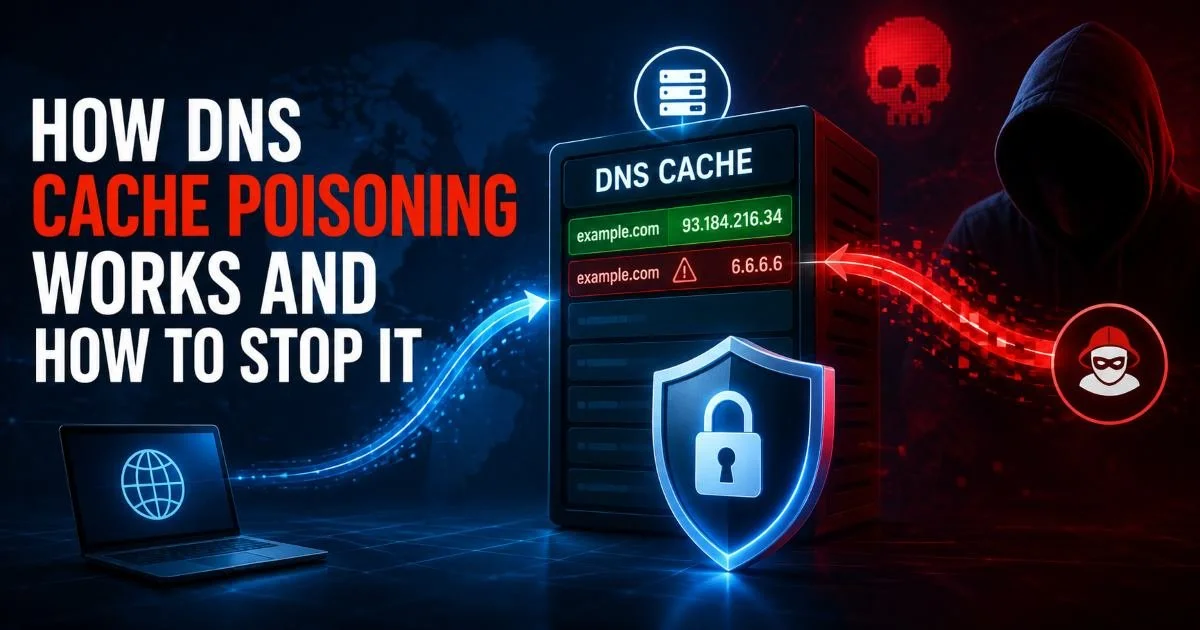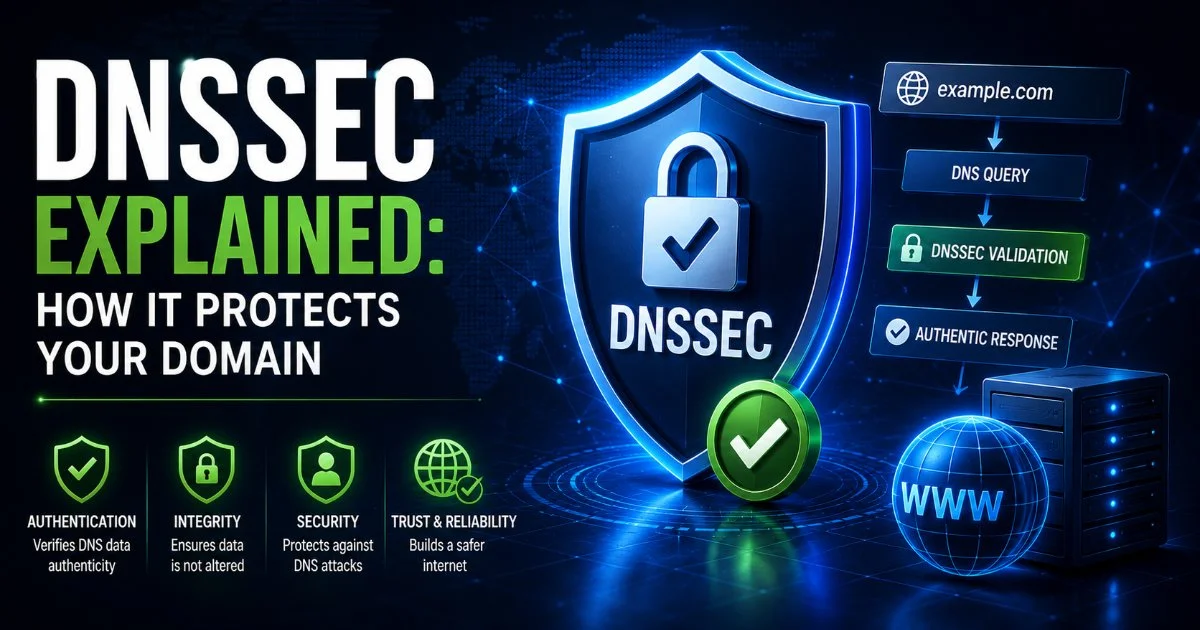
DNSSEC explained: how it protects your domain is a topic that every IT security professional should understand thoroughly, because the Domain Name System was never designed with authentication in mind. When a user types a URL into their browser, the DNS resolution process is inherently trusting. Without validation, attackers can inject forged responses, redirect traffic, and compromise entire organizations before anyone notices.
DNSSEC adds a layer of cryptographic verification to DNS responses, making it dramatically harder for bad actors to tamper with records. Understanding how DNS security works at a foundational level, as covered in our guide on DNS security definitions and examples, provides the context you need before implementing DNSSEC. This guide walks you through the practical steps of understanding, deploying, and maintaining DNSSEC for your domains.
Key Takeaways
- DNSSEC uses public-key cryptography to authenticate DNS responses and prevent cache poisoning attacks.
- Deployment requires generating key pairs, signing zones, and publishing DS records with your registrar.
- Key rollover procedures must be planned and tested before going live in production.
- Monitoring DNSSEC validation failures is essential to avoid silent resolution breakdowns for end users.
- Most major registrars and DNS providers now support automated DNSSEC management workflows.
Step 1: Understand the DNSSEC Chain of Trust
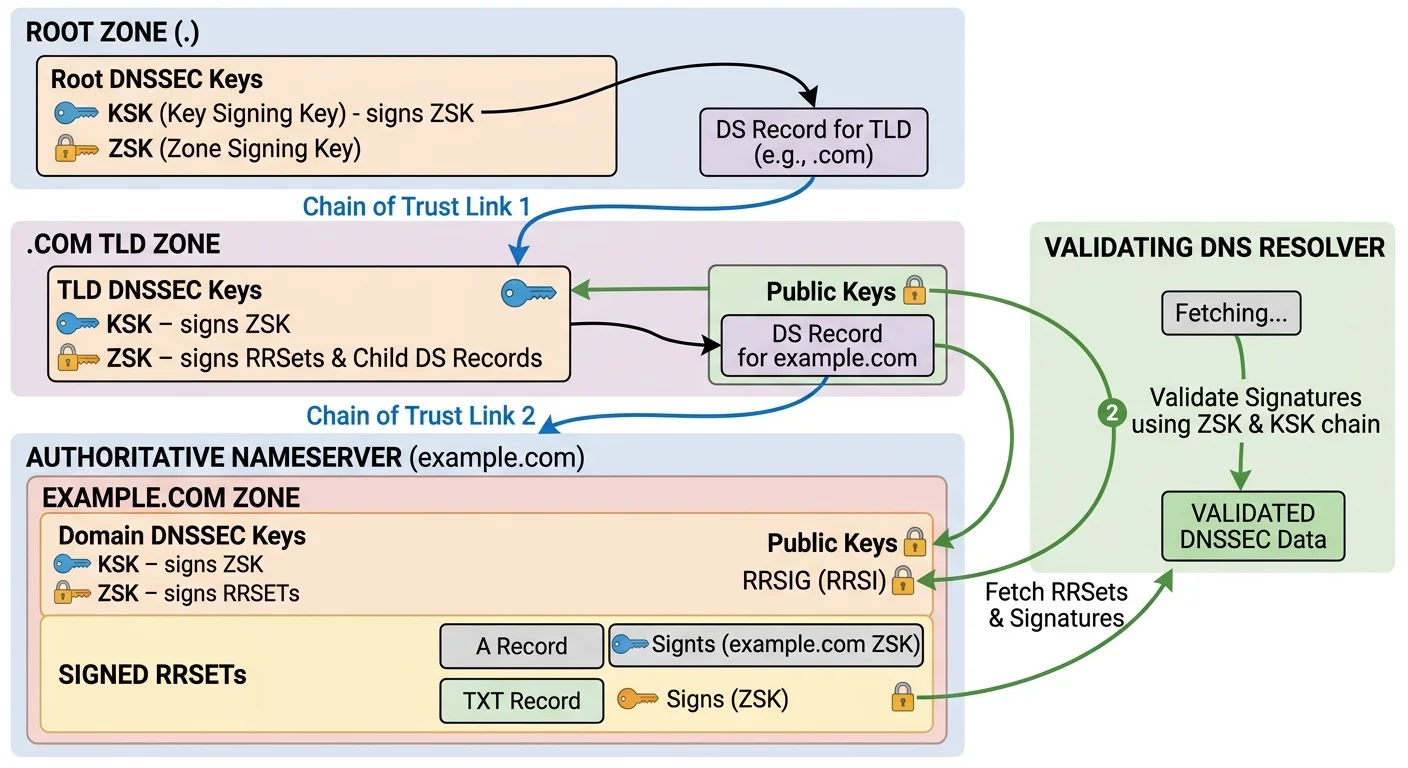
Before touching any configuration files, you need to understand what DNSSEC actually does at a protocol level. Standard DNS operates on blind trust: a resolver asks a nameserver for a record, and it accepts whatever comes back. DNSSEC adds digital signatures to DNS records, allowing resolvers to verify that the response originated from the authoritative source and was not modified in transit. This verification relies on a hierarchical chain of trust that begins at the DNS root zone.
How Signatures Flow from Root to Domain
The chain of trust works through a parent-child relationship. The root zone is signed with a well-known key that all validating resolvers trust implicitly. The root zone then holds Delegation Signer (DS) records for each TLD, like .com or .org, which point to the TLD's own signing keys. Each TLD, in turn, holds DS records for individual domains. This creates an unbroken chain from root to your specific zone.
When a DNSSEC-validating resolver receives a response, it checks the RRSIG (Resource Record Signature) attached to each record set. It retrieves the corresponding DNSKEY from the authoritative zone, then verifies that key against the DS record held by the parent zone. If any link in this chain is broken, missing, or tampered with, validation fails and the resolver returns a SERVFAIL to the client. This is the mechanism that stops cache poisoning and man-in-the-middle attacks cold.
Two key types matter here. The Zone Signing Key (ZSK) signs individual record sets within your zone. The Key Signing Key (KSK) signs the DNSKEY record set itself and is referenced by the DS record in the parent zone. Separating these roles allows you to rotate the frequently used ZSK without updating the parent zone every time, which reduces operational risk during key management.
DNSSEC does not encrypt DNS queries or responses. It only authenticates them. For encryption, consider DNS over HTTPS or DNS over TLS.
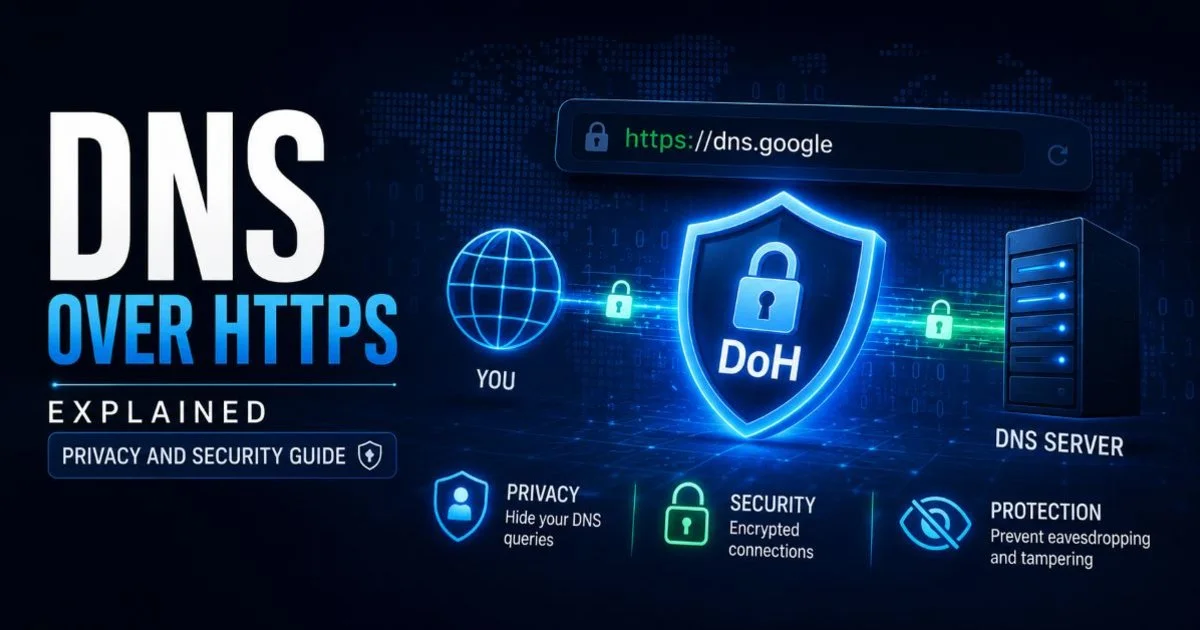
If you are also exploring encrypted DNS resolution as a complementary measure, our article on DNS Over HTTPS explained: privacy and security covers how encryption and authentication work together to protect domain traffic.
Step 2: Generate Keys and Sign Your DNS Zone
With the theory understood, the next step is generating your cryptographic keys and signing your DNS zone. If you manage your own authoritative DNS using BIND, PowerDNS, or Knot DNS, you will perform this locally. If you use a managed DNS provider like Cloudflare, AWS Route 53, or Google Cloud DNS, much of this process is automated, but you still need to understand what happens behind the scenes to troubleshoot issues.
Choosing the Right Algorithm and Key Size
Algorithm selection matters. RSA with SHA-256 (algorithm 8) remains widely supported, but ECDSA with P-256 (algorithm 13) produces significantly smaller signatures and keys, reducing DNS response sizes and improving performance. For new deployments, algorithm 13 is the recommended choice. The smaller key sizes (256 bits for ECDSA versus 2048 bits for RSA) mean less UDP packet bloat, which reduces the risk of DNS amplification and fragmentation issues.
| Algorithm | ID | Key Size | Signature Size | Recommendation |
|---|---|---|---|---|
| RSA/SHA-1 | 5 | 1024-2048 bits | ~128 bytes | Deprecated |
| RSA/SHA-256 | 8 | 2048 bits | ~256 bytes | Acceptable |
| RSA/SHA-512 | 10 | 2048-4096 bits | ~512 bytes | Not recommended |
| ECDSA P-256 | 13 | 256 bits | ~64 bytes | Preferred |
| Ed25519 | 15 | 256 bits | ~64 bytes | Best (limited support) |
On BIND 9, you would use dnssec-keygen to create both the KSK and ZSK. A typical command looks like: dnssec-keygen -a ECDSAP256SHA256 -f KSK example.com for the KSK, and the same without the -f KSK flag for the ZSK. After generating both key pairs, you include them in your zone file and run dnssec-signzone to produce a signed zone file containing RRSIG, DNSKEY, and NSEC or NSEC3 records.
Use NSEC3 instead of NSEC to prevent zone walking, which allows attackers to enumerate all records in your zone by following the NSEC chain.
DNSSEC explained: how it protects your domain becomes tangible at this stage. Once the zone is signed, every record set has a corresponding RRSIG, and the zone includes DNSKEY records that resolvers can use for validation. Reload your nameserver to serve the signed zone, but do not publish DS records to the parent yet. First, verify locally that the signatures are valid and the zone loads without errors.
Also Check: How to Measure Domain SEO Strength With Free Tools
Step 3: Publish DS Records and Activate Validation
Signing your zone is only half the work. Without a DS record in the parent zone, no resolver can build the chain of trust down to your domain. The DS record is a hash of your KSK's public key, and it must be submitted to your domain registrar. Most registrars now provide a web interface or API to submit DS records. You will need the key tag, algorithm number, digest type (SHA-256, or digest type 2), and the digest itself.
Publishing an incorrect DS record will break DNS resolution for your domain for all DNSSEC-validating resolvers. Double-check every value before submitting.
After submitting the DS record, propagation depends on the TLD's zone refresh interval. For .com, this typically happens within minutes. For some ccTLDs, it can take hours. During this window, your domain is in a partially signed state. Validating resolvers that have not yet seen the DS record will still resolve your domain normally, since they treat it as unsigned. Once the DS record propagates, the chain of trust activates.
Testing Your DNSSEC Deployment
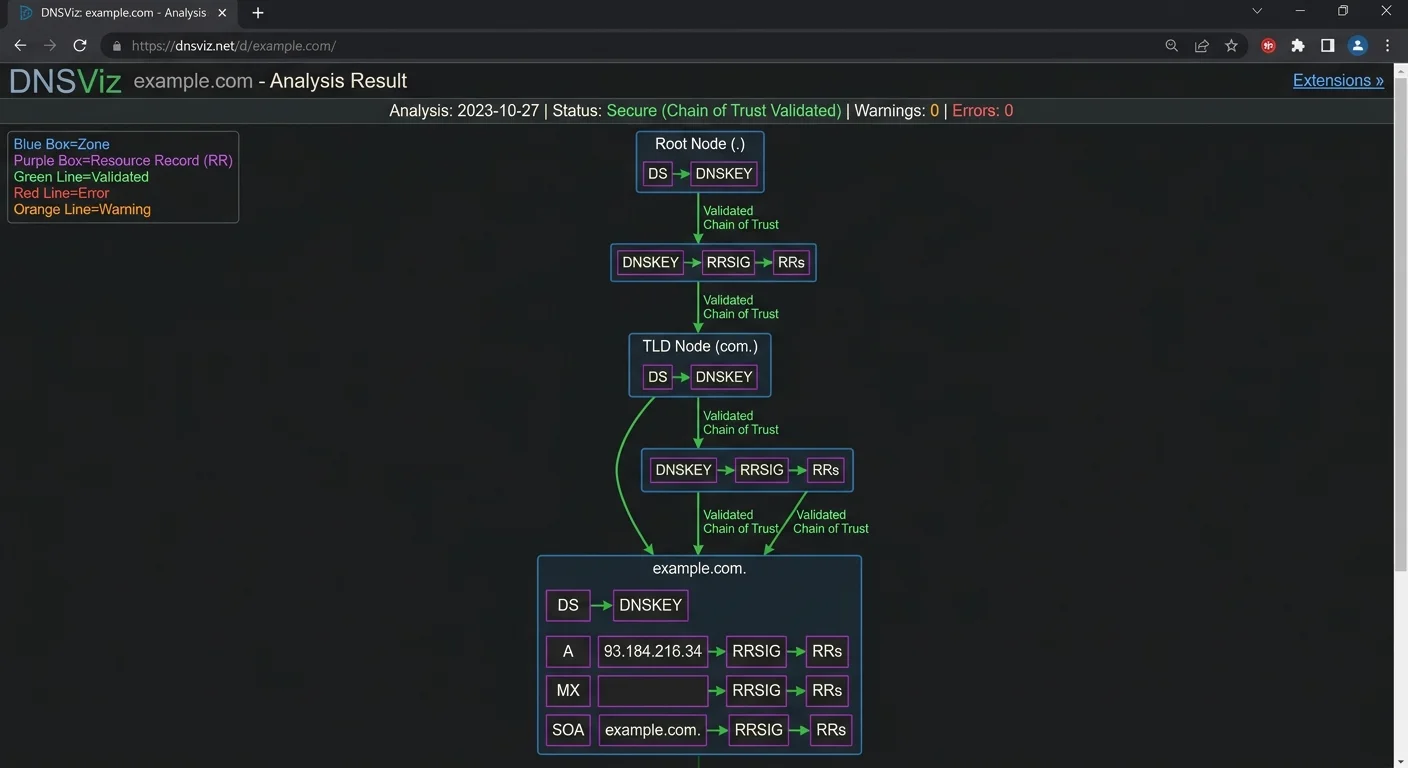
Use multiple validation tools to verify your deployment. DNSViz (dnsviz.net) provides a visual representation of your chain of trust and highlights any issues. Verisign's DNSSEC Debugger and the delv command-line tool (included with BIND) are also reliable for testing. Run delv @8.8.8.8 example.com A +rtrace to trace the validation path through Google's resolver. A successful test returns the response with a "fully validated" status.
Pay attention to the NSEC3 configuration if you chose it during signing. Incorrect NSEC3 parameters, particularly the iteration count, can cause validation failures or performance problems. RFC 9276 recommends zero additional iterations and no salt for NSEC3, which simplifies operations and reduces computational overhead on resolvers. When DNSSEC explained: how it protects your domain is understood at this testing phase, you gain confidence that your setup will hold under real-world conditions.
Step 4: Maintain, Monitor, and Roll Keys
Deploying DNSSEC is not a one-time event. Keys have lifetimes, signatures expire, and operational procedures must account for key rollovers. A ZSK rollover is relatively straightforward because it does not require updating the parent zone. The standard approach is the "pre-publish" method: publish the new ZSK in your DNSKEY record set before you start signing with it, wait for caches to expire, then begin signing with the new key and eventually remove the old one.
KSK rollovers are more involved because they require updating the DS record at the parent. The "double-DS" method publishes both old and new DS records simultaneously, then transitions the signing to the new KSK once the new DS has propagated. The timing must account for TTL values at both the parent and child zones. A botched KSK rollover can make your domain unreachable for hours, which is why testing in a staging environment first is strongly advised.
"A broken DNSSEC chain of trust is worse than no DNSSEC at all, because validating resolvers will refuse to resolve your domain entirely."
Automating Key Management
Modern DNS software has made key management significantly easier. BIND 9.16+ supports fully automatic DNSSEC key management with its dnssec-policy directive, which handles key generation, signing, rollovers, and retirement on a configurable schedule. Knot DNS offers similar automation. If you use managed DNS providers, services like Cloudflare handle all key operations automatically, including emergency key rollovers if a compromise is suspected.
Set up monitoring alerts for RRSIG expiration dates. If signatures expire before re-signing occurs, your domain will fail validation and become unreachable.
Monitoring is the final piece that ties DNSSEC explained: how it protects your domain into a production-ready workflow. Tools like Nagios plugins for DNSSEC, custom scripts using dig +dnssec, or managed monitoring services should check signature validity daily. Track your RRSIG inception and expiration timestamps, verify DS record consistency, and watch for DNSSEC-related SERVFAIL responses in your resolver logs. Without active monitoring, a silent configuration drift can turn your security investment into an availability problem.
Consider also documenting your key rollover procedures in a runbook. Include specific commands, expected outputs, rollback steps, and contact information for your registrar's support team. During a real incident, having a tested playbook reduces recovery time from hours to minutes. DNSSEC operations are not inherently complex, but they are unforgiving of mistakes when your domain's reachability depends on cryptographic correctness.
Frequently Asked Questions
?How do I update a DS record with my registrar after signing my zone?
?Can I rotate my ZSK without touching the parent zone DS record?
?How long does a full DNSSEC deployment typically take end to end?
?Does a SERVFAIL from failed DNSSEC validation affect all users or just some?
Final Thoughts
DNSSEC explained: how it protects your domain comes down to cryptographic authentication of DNS responses through a hierarchical chain of trust. The deployment process, from key generation to DS record publication to ongoing monitoring, requires careful planning but is well within reach for any IT security team.
The operational overhead is modest compared to the protection gained against cache poisoning and DNS spoofing attacks. Invest the time to automate key management, monitor signature expiration, and test rollover procedures regularly.
Disclaimer: Portions of this content may have been generated using AI tools to enhance clarity and brevity. While reviewed by a human, independent verification is encouraged.